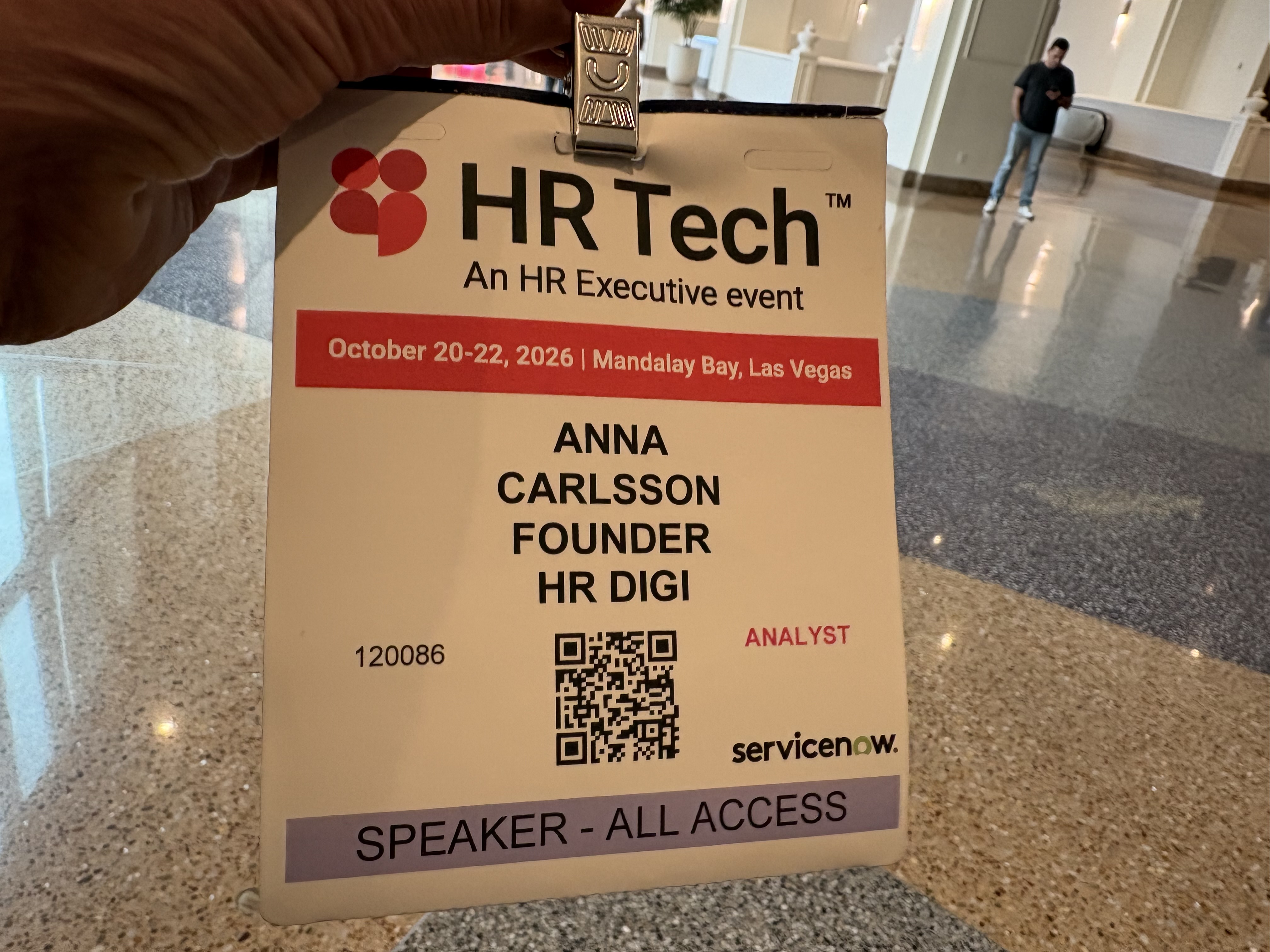
In October I was in Las Vegas for HR Tech, where buyers, users and vendors meet each year to explore where the market is heading. I came home with plenty of notes, a few questions and a growing sense that AI is helping HR recognise something I have been talking about for years: digitalisation is an ongoing responsibility.
In this month’s column, I explore that shift through four themes: integration, trust, cost and leadership. Together, they raise a question: if we could start over, would we build our organisations the way they are built today?
Two threads also run through this month’s news. AI agents are moving from helping us do the work to doing parts of it themselves, raising new questions about access, control and responsibility. At the same time, skills data is increasingly being treated as core infrastructure.
New reports and research bring us back to the people expected to make all this work. Gartner finds that only 38% of CHROs and CIOs share an understanding of how AI will affect the future of work. There is still a lot of work to do together.
As usual, you can find upcoming HR Tech and AI events and training at https://www.hrdigi.se/nyheter-eng/events
______________________________________
📅 This month’s invitations
Webinar: How do you measure digital HR maturity and the value of taking the next step? Åsa Landin and I explore how to assess where your organisation stands today, identify what to prioritise next and connect digital HR development to business value.
Click the link to read more and register. The first one is today!
Nordic HR AI Summit, Copenhagen, 6 to 7 January 2027. Sylvester & co’s summit on AI in Nordic HR. I am moderating Day 2, The CHRO Agenda, including the closing panel “HR in 2030: Bigger, Smaller, or Gone?”.
👉 https://www.sylvester-co.dk/nordic-hr-ai-summit-2027/
Not yet subscribed to the newsletter?
⇢ Register here for the newsletter in Swedish: go.hrdigi.se/nyhetsbrev
⇢ Register here for the newsletter in English: go.hrdigi.se/newsletter
______________________________________
The organisers of HR Tech in Las Vegas chose the theme “From Change to Transformation”. After three days of sessions, conversations on the expo floor and startups pitching on stage, I would choose a different word.
For me, the week was about transition.
For years, HR has treated digitalisation as a project. Something to plan, implement and complete, with a go-live date marking the finish line. But the work does not end when a system goes live. Our organisations, our needs and the technology keep developing.
I have been talking about this for years, so I am pleased to see AI helping that idea take hold. We need to keep adapting how we work, how we use our systems and what we expect them to deliver. One panellist described how the conversation has shifted each year since ChatGPT arrived. First came the sense of magic, followed by the discovery that AI could make things up and that our data needed attention. Then came the promise of agents, the questions about measurable value and the focus on people. This year, tokens and what all of this actually costs were firmly on the agenda.
The shift was visible on the expo floor too. Last year, it was full of AI assistants helping people write, summarise and search. This year, almost every booth had an agent to show: answering employee questions, handling tasks or running parts of the hiring process.
As AI moves into shared processes, the familiar questions return. How does the AI agent connect to our systems? Who can access which data? Who is responsible when something goes wrong? And how do employees need to work differently?
That is what transition means to me: an ongoing process in which both the technology and the organisation develop, and the destination keeps moving.
Four themes from the week illustrate what this transition means in practice: integration, trust, cost and leadership.
In May, Workday made its HR and finance agent available inside Microsoft Copilot, allowing employees to check their holiday balance or request leave without leaving the tool they already use. A few weeks later came the same for Google’s Gemini. In Las Vegas, Anthropic discussed similar connections for Claude with several of the large HCM and recruiting systems.
As it was put from the stage, it is no longer the AI inside the HR system. It is the HR system inside the AI. Employees can therefore carry out tasks in the HR system through the AI assistant they already use.
I experienced this myself in a completely different context when my podcast tool made it possible to manage my podcast through my preferred AI assistant. In my case, that is Claude. The same development is happening across many types of software.
I also noticed how often Claude came up in conversations at the conference, while I heard surprisingly little about Copilot. That felt different from the conversations I have back home in the Nordics, where Microsoft is so often the starting point.
I expect standards such as MCP, which allow AI tools to connect to other systems, to change how we build and use integrations. But the underlying work remains. Core systems still need to keep employee data consistent, manage permissions and support compliance, security and audit trails.
One company described how its employees had become the connection between systems, manually copying information from one tool to another. I see this in many organisations too, although it rarely gets much attention when we talk about digitalisation.
The same applies to knowing how the work is actually done. In the closing keynote, we heard about an organisation that believed 40% of its HR processes were documented. On closer inspection, only 30% were both documented and up to date.
That matters when we start introducing agents. We need to describe the work, the rules and the exceptions clearly enough for an agent to act within them. And we may discover that some of those processes need rethinking before we automate them.
The organisations best placed to benefit will be those that understand how their data, systems and work fit together. That has been important for years. AI makes it harder to postpone.
When I hosted a round table in Stockholm at the end of August, I was surprised by how many talent acquisition leaders had already encountered fake candidates. In Las Vegas, I heard more about what this can mean for organisations, especially when they hire people remotely who may work from another country and whom they never meet in person.
The speaker from Anthropic distinguished between different levels of fraud: from candidates using AI to misrepresent their experience to someone applying and interviewing under a false identity. According to him, recruiting system vendors estimate that around one in five candidates shows some level of fraud. Yet at a recent event, only seven out of 250 HR executives said that someone using a false identity was a real risk for their organisation.
Are we aware of the problem but still assuming it happens somewhere else?
Much of the hiring process now takes place online, and AI makes it easier to fabricate a CV or manipulate a face and voice in a video interview. A successful application can eventually give someone access to company systems and data. That makes candidate identity a concern for both recruitment and security.
The advice from the stage was practical: move identity checks earlier in the process and make sure there is at least one meeting in person.
For me, this raises a question about responsibility. How closely do talent acquisition and security work together today? Hiring has always involved assessing whether we can trust someone. We now also need to establish whether that person is who they claim to be.
For years, we have been used to paying a licence fee for our HR systems. AI introduces another cost model, where the bill can grow with usage. Every task an agent performs may involve several calls to an AI model. That makes costs harder to predict, especially as agents start doing more work on our behalf.
A new layer is also emerging: orchestration. Think of it as a conductor coordinating which agent does what, in which system and with which permissions. The data, systems and AI models involved may each come with their own charges. We need to understand what we are paying for at each step and where those costs overlap.
When the audience was asked about their orchestration strategy, very few hands went up. Few seemed to know who in their organisation owned the question. Many had apparently not considered it yet.
I understand why. We are still exploring what AI and agents can do for us, and the market keeps changing. But as HR, IT and procurement make decisions about different tools, someone needs to look at how they will work together and what the combined cost will be.
The discussion about value was just as revealing. Almost everyone measured AI in time saved. Only a handful measured the effect on a business outcome.
Time saved can be useful, but what happens to that time? Does it lead to better service, faster hiring or more time spent supporting managers? If we cannot answer that, it becomes difficult to judge whether a growing AI bill is money well spent.
HR’s technology reaches across the organisation, shaping the experience of employees, managers and candidates. The choices we make about AI therefore have consequences far beyond the HR department.
One panel referred to Ethan Mollick’s view of HR as the company’s new R&D function. I know that idea is debated, and I can see the opportunity. HR can help the organisation explore how work changes with AI, what people need to learn and what this means for leadership. That also requires us to look beyond our own processes.
And we need to be honest about how far we have come. In one survey presented on stage, 74% of US HR leaders believed they were adopting AI faster than the rest of their organisation. The response from the stage was a call for perspective: in many cases, that adoption still meant using a basic chatbot.
It reminded me of how most of us think we are better drivers than everyone else on the road. Enthusiasm is useful, but we need to distinguish between trying a tool and changing how work gets done.
The opening keynote captured the leadership challenge in one sentence: transformation cannot move faster than trust. People need to understand what is changing, have a say in how it happens and feel able to raise concerns. If we want them to take responsibility for new ways of working, we need to involve them in shaping those ways of working.
Another line from the same speaker is worth bringing into our everyday work: “AI is for preparation, humans are for presence.”
For HR and leaders, that is a useful reminder to think about where the time we save should go. Better preparation can create more room to listen, have a difficult conversation or support someone through a decision. But only if we choose to use it that way.
So, back to the question from the conference: if you could start over, would you build your HR processes and your organisation the way they are built today?
We cannot start everything from scratch. But we can use that question to challenge the choices we make next. Every investment in AI is an opportunity to reconsider the work itself, the systems supporting it and the experience of the people involved.
That is why I see this as a transition. There will be new tools, new possibilities and new decisions to make. Our responsibility is to keep developing with them.
For more reflections from the conference, listen to the latest episode of The HR Digi podcast, recorded on site in Las Vegas before I headed home.
In this month’s column, I describe how the HR system is moving into the AI assistant. Here is a Nordic example. Copenhagen-based Planday, owned by Xero, announced on 20 October that managers can now access its workforce scheduling tools directly through ChatGPT and Claude.
A restaurant manager could combine staff schedules with the weather forecast and table bookings, provided the booking platform is also connected, to assess staffing needs. The assistant can then help draft shifts or reassign staff in the same conversation. Every change requires the user’s confirmation, and existing Planday permissions still apply. Sensitive information, including bank details and payroll records, is excluded.
Planday reports that more than 160 customers have already connected. Access is available globally at no additional cost during the early-access period.
Refapp’s trend report on Talent Acquisition in Sweden is based on responses from 196 professionals in TA and recruitment, 81% of whom work in organisations with at least 250 employees. Of the respondents, 77% say their TA function has delivered the right talent at the right time, compared with 66% last year, but only 45% feel the function gets the resources it needs. The share who feel involved in the organisation’s strategic work has risen from 22% to 31%, and 48% have no TA representation in the leadership team. AI is used in recruitment by 47%, down from 52% last year, and only 35% have an AI policy for how recruiters may use the tools. Just 10% have a stated AI policy towards candidates. The biggest challenges are the wrong candidates, too few candidates and an offer that is not competitive enough. Some of the respondents are new since last year, so comparisons with 2025 should be read with caution.
Heartpace HR has compiled anonymised HR data from around 400 employers and 800,000 employees in ten Swedish industries for 2021 to 2025. The report describes the number of employees per manager as a common thread: as teams grow beyond 15 employees per manager, the risk of work-related sick leave rises, and beyond 20 it grows further. The median is 19 employees per manager in welfare and 22 in health and social care, where total sick leave is close to 12%. New hires are the most vulnerable group: 16% leave during their first year in welfare, one in five in health and social care and one in six in tech and finance. The gender pay gap is largest in finance at 12%, followed by tech at 10%, and in both industries women have the lower median pay. The data comes from Heartpace’s own customers and does not necessarily reflect the whole labour market.
At Workday Rising in Las Vegas on 13 October, Workday presented Autopilot agents for HR, finance and IT. The Talent Acquisition Agent can find matching candidates and support interview scheduling, but contact with candidates requires the recruiter’s approval. The autopilot mode is available to early adopters now, with general availability planned for early 2027, and autopilot versions of the Payroll and Deployment agents reach early adopters in early 2027. The same day Workday signed a binding agreement to buy C1.ai, which governs identities and access for both people and AI agents, including access outside Workday and the withdrawal of access once a task is complete. The price was not disclosed and the deal is expected to close by the end of January 2027.
SAP announced on 6 October an agreement to buy TechWolf, based in Ghent, Belgium, whose AI platform maps work tasks and skills. SAP takes over TechWolf’s context graph, AI models and applied research team, and TechWolf is expected to become a central part of the SuccessFactors portfolio. The price was not disclosed and the deal is expected to close in the fourth quarter of 2026. The same day, SAP began rolling out Joule Work, an AI interface where employees use SAP tools in plain language across SAP and third-party data. On the HR side, SAP mentions support for managers in closing skills gaps and for employees in choosing benefits. SAP says 110,000 of its own employees use Joule Work, with productivity gains of 20% in finance, HR and procurement; the figures are SAP’s own.
👉 https://news.sap.com/2026/10/sap-to-acquire-techwolf-evidence-based-work-age-of-ai/
👉 https://news.sap.com/2026/10/sap-connect-sap-puts-autonomous-enterprise-to-work/
Pearson announced on 29 September that it is buying Workera, a Palo Alto company founded in 2019 with around 60 employees. Workera measures skills through role-based simulations, for example a role play with a simulated manager, and since May also tracks skills development in the flow of work. Customers include ServiceNow and Accenture, and the platform connects to Workday and, through Kombo, to more than 200 HR and recruitment systems. Workera becomes part of Pearson’s Enterprise Learning and Skills unit. The price was not disclosed and the deal is expected to close in the second half of 2026.
Oracle launched Fusion Claw on 29 September, a runtime for Oracle Fusion Agentic Applications that lets a frontier model reason and plan while deterministic calculation carries out the work, with 25 new applications bringing the total to 75. For HR, Workforce Staffing builds staffing plans that take account of skills and certifications, availability, schedules, labour law and cost, and adjusts them as conditions change. At HR Tech in Las Vegas on 21 October, Oracle added Claw-powered applications for HR, among them Workforce Orchestration, which weighs development, redeployment, hiring and external talent, Workforce Compensation, which prepares budget-aligned pay recommendations against pay guidelines and equity considerations, and a Payroll Command Center that flags issues before a payroll run. Customers choose the level of automation for each process, actions are prepared for human review and approval, and every run produces an Outcome Receipt, an auditable record of the authority applied, the evidence used and the actions taken.
ServiceNow presented the third generation of EmployeeWorks on 15 October. Employees without coding skills can build their own AI assistants and recurring routines within limits set by administrators. The first specialised assistants come in HR Service Delivery: a Talent Insights Assistant that shows managers candidate fit and talent insights through integrations with Findem and Phenom, an HR Business Partner Assistant for approvals, cases and employee programmes, and a Manager Assistant for coaching and team performance. All the new features are in controlled availability, not general release.
Greenhouse launched Greenhouse in Claude on 22 October, a plugin that lets recruiters and hiring managers work with live hiring data without leaving Claude. They can ask what needs attention today, see stalled candidates and how long each has spent in every stage, prepare debriefs, see who still owes a scorecard and turn interview notes into a draft scorecard for the interviewer to review. With the right access, users can also move candidates forward, schedule interviews and create jobs and job posts. The plugin runs on Greenhouse MCP, each user signs in with their own Greenhouse account and admins decide which data and actions are available. It is in open beta for Greenhouse Recruiting customers on the Core, Plus and Pro plans.
Dayforce announced on 23 October an agreement to acquire Ribbon AI, whose software runs voice and video interviews with candidates at any hour, generates interview questions and scoring rubrics from a job description, and offers AI sourcing and outreach by SMS, WhatsApp and email. Ribbon reports hundreds of customers and more than 1 million completed interviews. Once the deal closes, the technology is to be integrated into the new Dayforce Agentic Recruiting experience. The price and the closing date have not been disclosed, so the acquisition is agreed but not completed.
Venero Capital Advisors counted 131 WorkTech acquisitions in Q3 2026, up 49% on the previous quarter. Of the companies acquired, 39 were AI-native, three times as many as a year earlier. AI-native companies also attracted 79% of investment capital. Venero describes a divided market, with slower-growing subscription software under valuation pressure while businesses embedded in payroll and regulation remain attractive.
A European Commission survey finds that 42% of SMEs and mid-sized companies use AI or algorithmic management, mostly in limited or experimental ways. Meanwhile, 49% do not trust automated systems to make decisions about staff. The survey covers 12,826 company leaders across the EU. Its definition includes algorithmic management, so the adoption figure should not be read as generative AI use alone.
👉 https://employment-social-affairs.ec.europa.eu/news/growing-use-ai-european-companies-2026-10-14_en
Only 28% of HR leaders surveyed by Valoir are confident that HR AI provides accurate answers about the workforce. Yet 36% plan to build autonomous AI workflows, and 10% of organisations have already used AI in a decision that led to someone being laid off, not hired or not promoted. Fewer than one in ten have the consistent processes, data and capabilities needed to manage workforce skills. The survey covers more than 200 HR executives worldwide and does not report results by region.
👉 https://www.valoir.com/publishedresearch/is-hr-ready-for-ai-2
Johannes Sundlo explores what happens when employees arrive with personal AI agents already familiar with how they work. As agents accumulate knowledge across private and company accounts, employers face questions about access, responsibility and what happens to that knowledge when someone leaves. The piece offers a perspective on an emerging workplace issue rather than new research.
👉 https://www.fullstackhr.io/p/hire-one-get-five-free
Gartner reports that 77% of board members expect productivity and cost savings from AI, while only 3% of organisations exceed their savings goals through productivity. The release does not disclose the methodology behind those figures. A separate survey of 297 CHROs found that 78% say their leadership lacks a shared view of where AI creates value, reinforcing the need to agree on outcomes before counting savings.
The aim of the newsletter is to write about news in the HR Tech market and the areas of digitalisation, AI and innovation for management and HR.
My name is Anna Carlsson and I am a strategic adviser and HR Tech analyst. I help HR and management make sound decisions within HR Tech, AI and digitalisation, through strategies that are clear, durable over time and possible to carry out. Assignments range from an hour of advice to longer projects where I follow you all the way from current state to result.
I run HR Digi, which supports HR practitioners and HR Tech companies to navigate, understand and lead in a digital age. And it is not always a large change that is needed, sometimes it is enough to clarify, prioritise and communicate strategically to succeed.
Read more at hrdigi.se or book a digital coffee with me.
Also a proud member of the Top 100 HR Tech Influencers globally 2024, 2025 & 2026 🙏