This month's column is about the Pay Transparency Directive, whose deadline just passed, and an insight that weighs more than the timeline: that the same foundation required for compliance is the one AI and capability management rest on. Beyond that: OpenAI opens a Nordic office in Stockholm, Nordic funding around Factorial and Headcount HR, and global launches where Workday and Salesforce push agentic HR forward.
Upcoming events and training in HR Tech and AI are gathered as usual at hrdigi.se/news/event.
_____________________________________
📣 This month's invitation, together with Teamdash
AI in talent acquisition: building the TA function for 2027 and beyond
On 25 August, Anna Carlsson will co-host an invite-only breakfast roundtable at Fotografiska Stockholm together with Teamdash and Renita Käsper. The conversation will cover how AI is changing talent acquisition, what teams need to prepare for next and what should remain human in hiring.
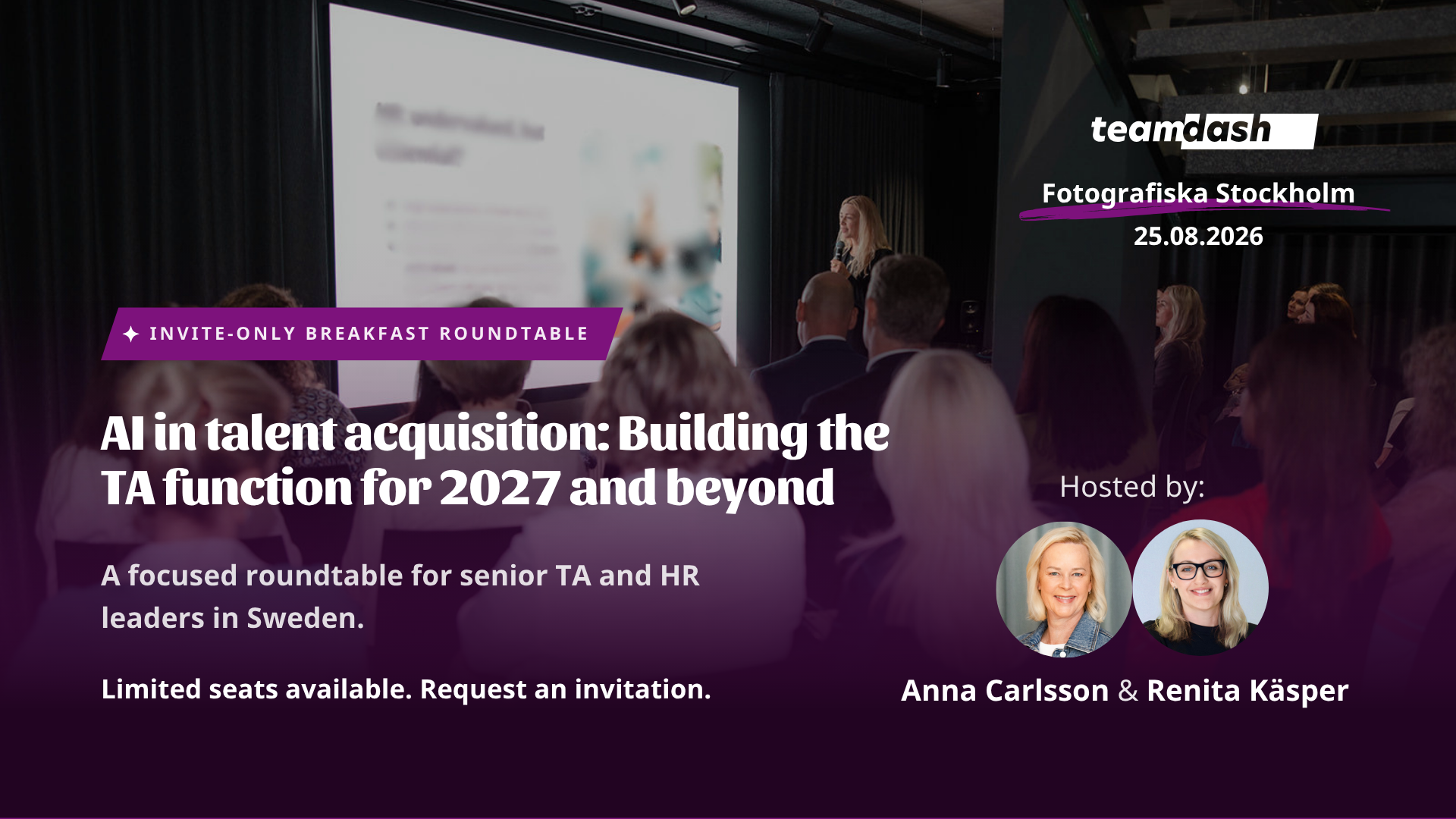
The event is designed for a small group of senior TA and HR leaders to keep the conversation practical, focused and useful. Places are limited and participation will be confirmed individually.
👉 Read more and register your interest!
_____________________________________
Aren’t you already subscribed to the newsletter?
⇢ Register your e-mail here for the newsletter in English.
⇢ Sign up with your email here for the newsletter in Swedish.
On 7 June, EU member states were due to have transposed the Pay Transparency Directive into national law. Only four countries made it: Italy, Slovakia, Lithuania and Malta. Several others, including Sweden and Denmark, have already confirmed delays, and Sweden is now aiming for 1 January 2027. To many HR functions this may sound like a reprieve to breathe out before. But the deadline is the only thing that has moved. The need to prepare remains.
The most interesting thing about the directive is that the foundation required to meet it is increasingly the same foundation AI in HR rests on. Both depend on clear job architectures, defined role and level structures, consistent compensation frameworks and reliable workforce data. The technology conversation is moving towards AI agents and automation, but many organisations still lack the underlying structures needed to carry either. It is no coincidence that those who already have their data in order move fastest, whether the goal is compliance or agentic AI.
Here lies a trap. Many employers are now reviewing their job architecture precisely to meet the directive, and there is nothing wrong with that in itself. The problem is that the work is most often done purely as a compliance exercise. That misses the bigger opportunity, the one that creates value regardless of what happens with the directive and its timeline. The same foundation can also answer the broader questions of capability and skills. Most organisations still have thin data on which capabilities actually exist. How then do you know whether you have the right capabilities to deliver on your goals? Where is the organisation exposed? Where do you need to develop, recruit or rethink how work is done? That is where the real business value sits.
The conclusion is therefore easy to state, if harder to live. Don't wait for the directive, and don't build the foundation just to fill a box. The organisation that puts job architecture, level structure and capability data in place now does it to make better decisions about its people, not just to pass an audit. And the benefits don't stop there: once the structure is in place, transparent pay can be surfaced directly in job ads, and compliance suddenly becomes a recruitment advantage. The deadline may have slipped in several countries. The opportunity to make something real of the preparation has not. You'll find more on both the Pay Transparency Directive and Strada's report in the news items below.
As usual I group the news into four areas: Nordic product news and launches, Nordic consolidation and M&A, research and reports, and global product launches. The source sits directly after each item.
On 18 June, OpenAI announced that it will open its first Nordic office in Stockholm in the second half of 2026, with a mandate to act as a hub for the whole Nordic region. The decision is motivated by Sweden being one of the company's fastest-growing markets in Europe: weekly ChatGPT users are up more than 50 percent in a year, use of the coding tool Codex has grown tenfold since the start of the year, and API traffic has almost quintupled.
For Nordic HR the move is more than symbolic. When one of the global AI players moves closer to the market, both the supply of and the competition for talent increase. It sharpens the pressure on employers to hold a deliberate position on how generative AI should be used internally, rather than leaving it to employees' own initiative.
👉 https://www.svt.se/nyheter/inrikes/open-ai-oppnar-kontor-i-stockholm
The Nordic recruitment platform The Hub, of Danish origin, launched version 2.0 on 26 June with built-in AI for job-ad copy and candidate ranking, plus voice features. The platform, with around 850,000 registered candidates, simultaneously raised 10 million Norwegian kronor from Nordic business angels, including Aksel Lund Svindal.
The news shows that AI-driven recruitment is now reaching the Nordic mid-market in earnest. For Nordic HR leaders the question to watch is how AI-based candidate ranking affects candidate experience and diversity in practice, a theme several of this month's research reports return to.
👉 https://arcticstartup.com/the-hub-raises-e896k/
On 25 June, Norwegian Attensi announced that it had been included in Training Industry's list of the top 20 AI coaching and learner-support tools for 2026. The recognition relates in particular to RealTalk, an AI-driven conversation simulation where employees practise difficult workplace situations with immediate feedback. The list does not rank the companies against each other.
Attensi, which builds game-based simulation training and reports customers in more than 150 countries, is one of few Nordic companies visible in the global top tier of AI-supported learning. It is a sign that simulation and practice, not just content, are becoming the next competitive front in L&D.
👉 https://trainingindustry.com/top-training-companies-ai-coaching/
The Spanish HR platform Factorial confirmed a Series D round of 150 million dollars, around 1.5 billion kronor, in early June, at a valuation near 2.5 billion dollars. The round was led by US-based General Catalyst, with the London-based venture firm Atomico, founded by Swede Niklas Zennström, among the investors.
Factorial targets small and mid-sized companies with an all-in-one platform and is now one of Europe's fastest-growing HR Tech players. That capital of this size goes to a European alternative, with Zennström's Atomico among the owners, is worth noting for Nordic buyers who are otherwise often steered towards the large American platforms.
👉 https://tech.eu/2026/06/03/factorial-raises-150m-series-d-at-25b-valuation-to-expand-across-europe/
The Swedish AI-driven HR startup Headcount HR, founded by Mitra Pashang, has closed an angel round. Former Klarna executive Camilla Giesecke, known as one of the architects behind Klarna's global expansion, joins as lead investor. The amount has not been disclosed.
That an experienced fintech profile chooses to invest in AI-native HR technology signals growing interest in the segment among Swedish startup veterans. Headcount HR is one of few Swedish HR startups to have closed funding in the period, and the Giesecke name raises credibility ahead of the next phase.
On 7 June, the deadline expired for EU member states to transpose the Pay Transparency Directive into national law. Only four countries, Slovakia, Italy, Lithuania and Malta, met the deadline, while several others are aiming for 1 January 2027. Sweden voted against the directive and has paused implementation with a request to renegotiate. Legal observers note that courts can already interpret existing national law in light of the directive, meaning the right to learn one's position in the pay range may take practical effect before it exists in local law.
For Swedish HR leaders the delay means the formal obligations are pushed forward, but not that preparation can wait. Work on pay structures, job classification and pay mapping should continue as planned. It is the same foundational data required for both pay transparency and agentic AI, which makes the work doubly worth doing now.
Three in four large employers have invested in a modern HCM platform, yet still rely on manual workarounds alongside it. That is the figure that stands out in Strada's Workforce Possibility Report 2026, based on 405 senior leaders in organisations with more than 1,000 employees. 74 percent have moved HR and payroll to the cloud, but only 29 percent say they have seen a meaningful improvement in outcomes; the rest are still waiting for the value they expected. On average, organisations estimate that 2.6 percent of annual payroll spend is lost to errors and rework, and 81 percent of leaders say complexity now holds back strategic priorities, including AI.
According to Strada the problem is rarely the software itself, but the environment around it, and that pattern is familiar in many Nordic organisations. When processes require constant checks and workarounds, the platform is seldom the culprit. Those seeing the strongest results are not necessarily using different systems; they have integrated them better, and fully integrated environments outperform others on 90 percent of the metrics measured. The study is global and lacks a Nordic sample, but the pattern is unlikely to look very different here.
👉 https://stradaglobal.com/workforcepossibility
In a study published in late June, ManpowerGroup and Everest Group show that more than 90 percent of organisations now use AI in recruiting, but that fewer than 5 percent achieve genuinely transformative results. The survey is based on around eighty senior leaders in the US and UK, and the main cause is said to be fragmented data systems and siloed technology.
The study confirms what many Nordic HR leaders experience in practice: AI tools are added without the underlying data infrastructure being reviewed. Buying more AI does not solve the problem if integrations and data quality are not in place. It is the month's clearest evidence that the bottleneck sits in the foundation, not in the models.
On 18 June, PwC published its 2026 Global AI Jobs Barometer, based on more than a billion job ads across six continents. Jobs requiring AI skills grow almost eight times faster than the labour market overall, and the wage premium for AI-skilled employees now stands at 62 percent. AI is creating what PwC calls a two-track labour market: companies with high AI exposure grow faster and pay more.
A 62 percent wage premium is sustainable neither as a recruitment nor a retention strategy in the long run. For Nordic HR the conclusion is clear: organisations that do not actively build AI skills internally risk facing a capability gap that becomes more expensive to close with each passing year.
👉 https://www.pwc.com/gx/en/services/ai/ai-jobs-barometer.html
Thomson Reuters' Future of Professionals report for 2026, a global survey of around 1,800 lawyers, accountants and compliance experts across 62 countries, shows that roughly one in three use AI tools their employer has not approved, even though official solutions often exist. The figure was picked up in Sweden by Dagens Industri. The pattern is confirmed by a study from Remesh, where only 44 percent of organisations say they have clear guidelines for how employees may use AI.
The growing gap between AI policy and actual use is a central HR challenge. Governance requires more than control; it requires clear guidelines, training and an open conversation about why employees choose unofficial routes. That the pattern appears across 62 countries shows it is a structural phenomenon, not a quirk of any single market, and something HR needs to own.
The analyst house RedThread Research published two road reports in mid-June from Oracle's and UKG's analyst days, pointing in the same direction: the large HCM vendors now frame agentic AI as a unified platform rather than individual features. Oracle is described as building an agent layer around business outcomes with a pricing model that bakes AI into the suite, and UKG highlights a platform with four agent products built partly on MCP. RedThread notes that questions of responsible AI, change management and total cost of ownership remain partly unanswered.
For Nordic buyers ahead of coming HCM procurements this is an important shift. When AI is baked into the suite instead of priced separately, the calculation changes, and the unanswered questions about cost of ownership and governance become the buyer's responsibility to raise before the contract is signed.
👉 https://redthreadresearch.com
At its DevCon on 2 June, Workday presented three new things: Agent Passport, a system for verifying and monitoring AI agents; a Developer Agent that lets developers build applications via natural language; and a deeper data-cloud integration. In parallel, the Google Cloud partnership was expanded, with Workday's self-service agent integrated into Gemini Enterprise and the whole connection built on the open protocols A2A and MCP.
Agent Passport is a direct answer to how organisations can control and trace AI agents acting in HR processes. For Nordic Workday customers it is a step towards making agentic AI more transparent and auditable, and the choice of MCP and A2A signals the direction for how HR systems will talk to each other without bespoke integrations.
Salesforce has begun sharing results from its own use of Agentforce HR Service. Over ten months the platform has handled more than 200,000 conversations with a 96 percent self-service rate and nearly 10 million searches in the employee portal. The solution ties together SAP, Workday and Slack in an interface where employees can complete everyday tasks via conversation. The figures are Salesforce's own and describe the company's internal deployment.
That one of the large players shares concrete operational figures, even if for its own use, is a sign that the conversation has moved from demo to measurable result. For Nordic HR teams 96 percent self-service is an interesting reference point, but the figure says as much about the data quality and process behind it as about the agent itself.
👉 https://hrexecutive.com/how-salesforce-transformed-employee-experiences-with-agentforce-hr-service/
In late June, LinkedIn launched Premium Apply Assistant, which automatically fills in application forms and generates cover letters for Premium subscribers. The feature builds on the platform's investment in AI-driven career coaching.
The news raises an uncomfortable question: what does CV screening actually measure when the applications themselves are AI-generated? Nordic recruiters need to consider how processes can be designed to distinguish candidates' real competence and drive, rather than their ability to have a model write for them.
These are exactly the questions explored at the breakfast roundtable on 25 August, see the invitation at the top of this newsletter.
Indeed has launched Smart Screening, an AI-driven tool that automates candidate screening in high-volume hiring via a so-called Smart Fit Score and conversational screening. The aim is to free up recruiters' time in an environment where the number of applications per role has surged, not least because of AI-generated applications.
For Nordic teams with large hiring volumes the launch addresses a real problem. The question is how well the tool handles the bias risks several of this month's studies point to: when the whole market leans on the same kind of algorithm, there is a risk that the same candidates are systematically filtered out.
👉 https://www.indeed.com/employers/smart-screening
The Madrid-based startup Orbio closed a Series A round of 21 million dollars in mid-June, led by Dawn Capital. The company offers AI agents that automate interviews, onboarding and follow-up for frontline workers without a company email, in sectors such as restaurants, logistics and care. At customers such as YUM! Brands the company says the share of candidates who complete the process rises by 20 percent.
Frontline workers are a segment long overlooked in HR Tech innovation, and Orbio points to a real market gap. Nordic companies with a large share of hourly staff should watch the segment closely, as European players are now moving into the same niche.
The newsletter covers developments in the HR Tech market and explores how digitalisation, AI and innovation are shaping the future of HR and business.
About me, the author
My name is Anna Carlsson and I'm a strategic advisor and HR Tech analyst. I help HR and management make better decisions around HR Tech, AI, and digitalization – through strategies that are clear, sustainable over time, and implementable. My work ranges from one-hour advisory sessions to larger projects, supporting organisations from initial assessment through to implementation and results.
I run HR Digi, which supports HR practitioners and HR Tech companies to navigate, understand, and lead in a digital age. And it's not always a big change that's needed – sometimes it's enough to clarify, prioritize, and communicate strategically to achieve success.
Read more at hrdigi.se or Book a virtual coffee with me.
Also a proud member of the group Top 100 HR Tech Influencers globally 2024 & 2025 🙏