The first snow has fallen across Sweden and advent is around the corner. I’ve just returned from nearly two months as a digital nomad in southern Europe – working from different spots along the Spanish and French Mediterranean coast.
Over these past weeks, several major reports have been released, all painting a remarkably consistent picture of where we stand on AI, tech and data. I’ve already shared some of these insights — and the rest you’ll get today.
My takeaway this time is clear: 2025 is the year reality caught up. 2026 is the year organisations MUST start investing if they want to succeed.
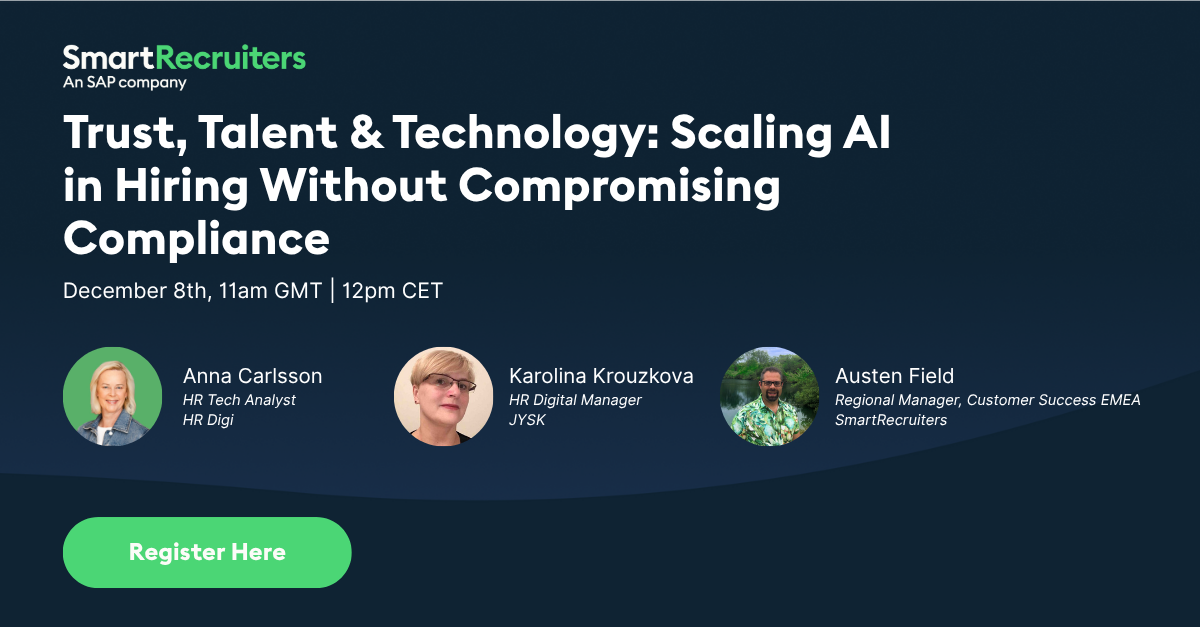
And — finally — the registration link is now live for the upcoming event with SuccessFactors’ latest acquisition, SmartRecruiters, together with customer Jysk:
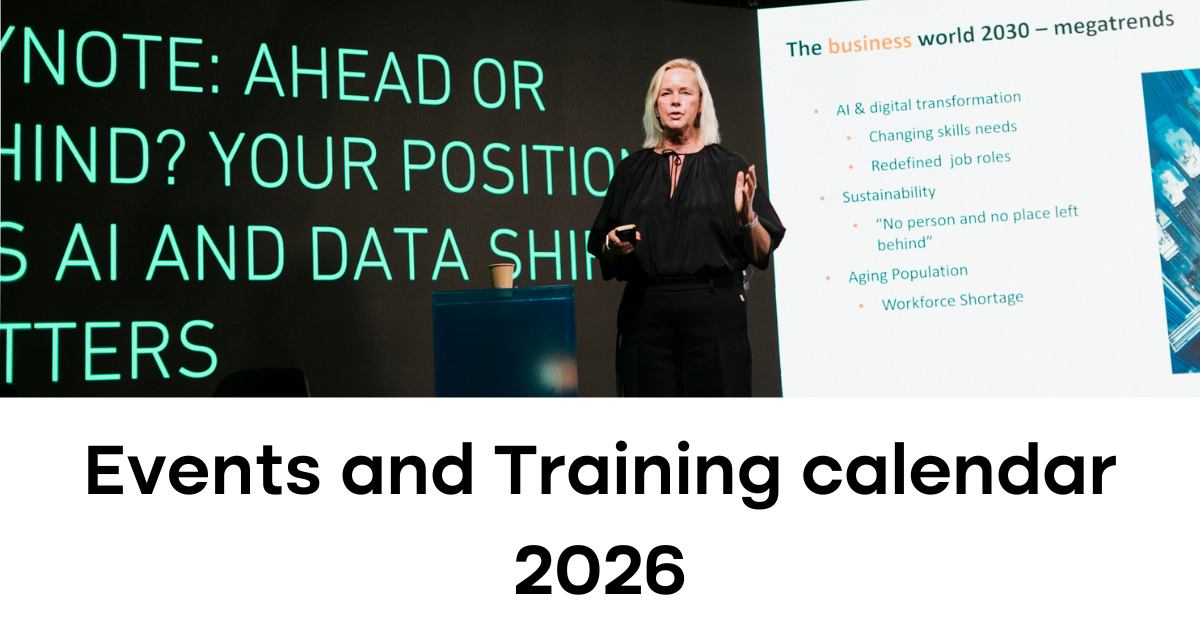
Planning your activities for next year? The 2026 event list is now live on the website:
Aren’t you already subscribed to the newsletter?
⇢ Register your e-mail here for the newsletter in English.
⇢ Sign up with your email here for the newsletter in Swedish.
November 2025 gives us an unusually consistent picture from the major HR reports that have landed in my inbox:
AI is here, but most organisations don’t know what to do with it.
88% use AI at work globally. But only 28% of organisations achieve transformative results, according to EY’s study of 15,000 employees. In Sweden, the situation is even worse — we rank second to last in the world with only 15% daily AI usage. India leads with 61%.
What’s the problem?
It’s not the technology. Sapient Insights’ report shows that 86% of all HR Tech investments go to AI, while overall budgets have shrunk by 29% over five years. Yet 29% don’t even know their systems have AI features. A third use Shadow AI — turning to their own tools without oversight because they feel the right tools aren’t available at work.
TNG’s Swedish survey confirms the picture: 72% of white-collar employees use AI, but 44% of managers say their organisation has no AI strategy, and 77% don’t measure any outcomes.
The Nordic HR report shows that Sweden is not alone — but we are falling behind our neighbours on two critical fronts.
First, organisationally: Finland has the strongest executive-level influence on digital and tech-strategic issues.
This matters because there is a clear link between digital maturity and strategic influence. Organisational resistance is the biggest barrier to transformation.
Second, technically: Only 54% of Swedish organisations have a basic HCM/HRIS/HRM system — compared with 83% in Norway, 61% in Denmark and 67% in Finland.
Almost half of Swedish organisations lack the digital infrastructure needed to even start talking about AI transformation.
EY’s data reinforces this: while Sweden sits at 15% daily AI use, Norway is at 22%, Denmark 19%, and Finland 20%. Even our Nordic neighbours struggle compared with the global average of 37% — but Sweden is dead last.
Here’s where it gets interesting. Managers use AI more than employees — but only 11% consider AI skills important when hiring.
Meanwhile, 45% of candidates use AI when applying for jobs, and 41% say it’s important that employers invest in AI.
We are facing a massive leadership gap: employees are moving ahead, managers are guessing, and no one is measuring anything.
EY’s research shows that those who achieve transformative results don’t have better tech — they have better focus.
They systematically build five capabilities:
But it comes at a cost: 81+ hours of AI training yields 14 hours/week in productivity — but also a 55% higher risk of employees leaving.
Fosway’s European analysis points toward the future: strategic workforce planning is now the #1 priority.
It’s no longer just about skills — it’s about tasks: what should humans do, what should AI do? Fewer than 20% of companies have reached this stage.
2025 is the year when reality caught up. 2026 is the year organisations must invest.
AI doesn’t work as a side project — and certainly not without basic infrastructure.
When 46% of Swedish organisations lack a basic HR system, when the entire Nordic region is below the global average in daily AI usage, and when only 3% say their HR solutions work seamlessly together, we are trying to build AI transformation on very shaky ground.
The organisations that succeed understand one thing:
Transformation requires systematic excellence in people first, functional systems and infrastructure second — and technology last.
The question is no longer whether AI will change working life.
The question is whether Swedish organisations can build both the talent base and the technical foundation needed — before their competitors do.
As I’ve already written, here are the reports that inspired this month’s column. But first, a few other updates — including, of course, the big topic everyone is talking about: the EU AI Act.
The proposal to push the full application of the high-risk requirements to December 2027 received a lot of attention in the press at the end of last week. My impression is that many thought the law would be stopped. But no — it simply means that the requirements will be reviewed and that some parts will get more time to be implemented.
Here’s what actually matters for those of us working in HR, digitalisation and HR tech:
1. More time – but the same high requirements
The timeline becomes longer, but the regulation itself remains intact. Vendors still need to build governance, transparency and risk management — and HR needs to plan for this now, not wait for “later”.
2. Recruitment and automated decision support move into the spotlight
AI features such as matching, selection, scoring and assessment will face even closer scrutiny as the definitions of high-risk systems are refined. The question going forward isn’t if but how we document models, data sources and decision logic.
3. Sweden risks falling behind — again
A delayed deadline easily makes Swedish organisations relax too much. Internationally, the pace is accelerating — and those who continue building AI governance now will be strongest when the requirements take effect.
You’ll find the EU’s official page on the AI Act at the link:
👉 https://digital-strategy.ec.europa.eu/en/policies/regulatory-framework-ai
The Swedish AI startup Triform has, during 2025, launched a platform for AI agents that automates complex workflows in a scalable and cost-efficient way. The solution combines visual and code-based tools and is built with full focus on EU data protection and secure infrastructure.
With this launch, Triform positions itself as a Swedish competitor to international automation services like AI.work — but with a clearer focus on local data management and control.
On 3 November 2025, Workday announced that it has finalised the acquisition of the Swedish AI company Sana Labs in a deal valued at approximately USD 1.1 billion (over SEK 10 billion). The company emphasises that this is only the beginning, with the ambition to bring superintelligence into the workplace.
Workday will integrate Sana’s AI-driven search, agent and learning platforms to create an intelligent and personalised work experience — described as “the new front door for work” — providing seamless access to data and automating tasks to improve productivity and focus.
The interpretation app Care to Translate wants to help healthcare stop “misusing” Google Translate and serve as a complement to human interpreters. The company has now secured SEK 10 million in new funding from existing investors. With this new capital, Care to Translate continues to grow both within Swedish healthcare and internationally. The timing is ideal — the need for reliable language tools is rising rapidly due to staff shortages, increasing patient volumes, and higher demands on quality, safety and equitable care.
For HR in the public sector and healthcare organisations, this is yet another sign that language technology is becoming a central component of future workforce planning, onboarding and the work environment.
What should we focus on to succeed with our AI transformation?

👉 https://www.ey.com/en_gl/insights/workforce/work-reimagined-survey
Nordic HR Trends and Tech Survey 2025/26 compares how HR is developing in Norway, Sweden, Denmark and Finland by examining HR’s strategic influence, business impact, digital maturity and readiness for upcoming compliance requirements.
The Nordic HR Trends and Tech Survey Report is based on a Nordic study conducted in collaboration with Sveriges HR-förening, Danske HR, the Finnish HR association HENRY, and CatalystOne. More than 500 HR professionals from across the Nordics participated. To access the full report, you need to be a member of HR-föreningen.
👉 https://hrforeningen.se/nyheter/the-nordic-hr-trends-tech-report-2025-26/
This year’s report shows that USD 17 billion was invested in HR Tech in 2024, but also that 29% of HR professionals are unaware that their own systems contain AI features. The report also highlights Shadow AI as a growing challenge, where employees use AI without official governance or policy.
The report is primarily based on U.S. data, but Swedish organisations also contribute insights.
👉 https://sapientinsights.com/downloads/28th-annual-2025-2026-hr-systems-survey-key-findings/
Want me to come and talk about future challenges, choices, and strategies with your team? You can reach me at anna.carlsson@hrdigi.se.
The purpose of this newsletter is to share news from the HR Tech market and highlight trends in digitalization, AI, and innovation for leaders and HR professionals.
About me
My name is Anna Carlsson, and I’m a strategic advisor and HR Tech analyst. I help HR and leadership teams make smart decisions in HR Tech, AI, and digitalization – through strategies that are clear, sustainable over time, and actionable. Assignments range from one-hour advisory calls to long-term projects where I support you all the way from current state to concrete results.
I run HR Digi, supporting HR professionals and HR Tech companies in navigating, understanding, and leading in a digital era. And it doesn’t always take major change – sometimes it’s about clarifying, prioritizing, and communicating strategically to achieve success.
Also proud member of Top 100 HR Tech Influencers 2024 & 2025 🙏